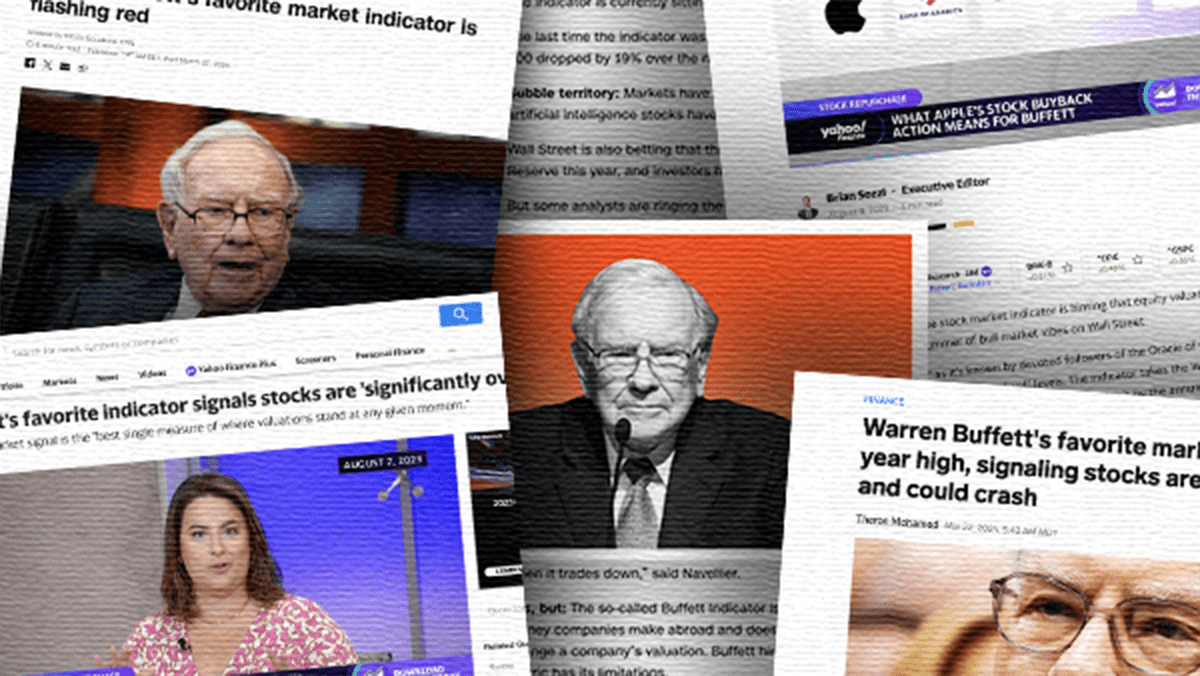
Buffett Indicator Hits Record High of 208% — Is a Stock Market Crash Coming?

Key Points


• A market valuation metric popularized by Warren Buffett is at an all-time high of roughly 208%.
• Buffett has said that anytime this indicator approaches 200%, investors are “playing with fire.”
• History has proven Buffett right in the past.

Even after Warren Buffett steps down as CEO of Berkshire Hathaway (NYSE: BRK.A) (NYSE: BRK.B), his legacy will live on. So will an indicator that bears his name.


Buffett told Fortune magazine in 2001 that this metric, now known as the Buffett indicator, is “probably the best single measure of where valuations stand at any given moment.” And now the Buffett indicator is at the highest level ever, sending a warning.

What is the Buffett indicator?


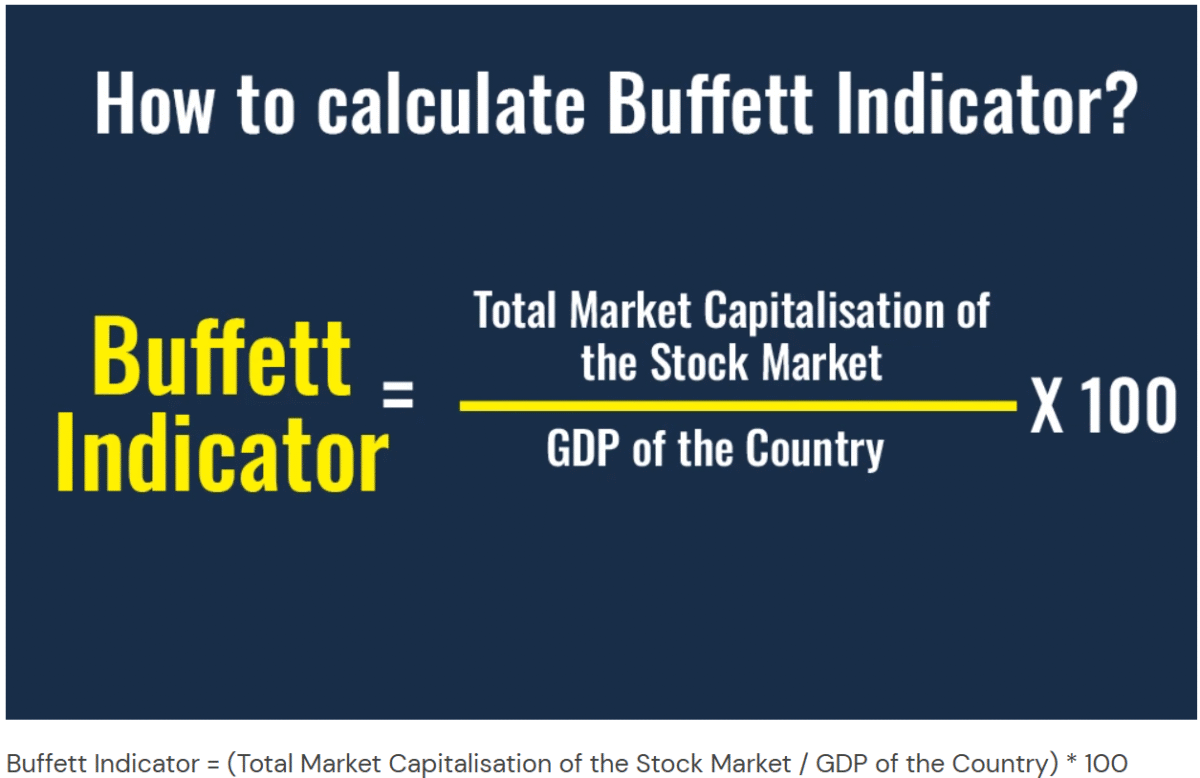
The Buffett Indicator measures the ratio of the total U.S. stock market capitalization to U.S. Gross Domestic Product (GDP).

  • Low Readings (70–80%) → Historically great buying opportunities.
  • High Readings (200%+) → Elevated risk of overvaluation.

Originally, Buffett used Gross National Product (GNP), but GDP is now more commonly applied in the calculation.

The Buffett Indicator, also known as the Market Cap to GDP Ratio, is a valuation metric used to assess whether the stock market is overvalued or undervalued relative to the economy. It is calculated by dividing the total market capitalization of a country’s stock market by its gross domestic product (GDP). 

Here’s the formula:

Buffett Indicator (%) = (Total Stock Market Capitalization ÷ Gross Domestic Product (GDP)) × 100 
In a sense, the Buffett indicator is similar to the most widely used stock valuation metric — the price-to-earnings ratio. Instead of the share price of a single stock, the total market cap of all U.S. stocks is used. Instead of the earnings generated by a single company, the metric uses the total value generated by everyone in the U.S.

With the Buffett indicator and the price-to-earnings ratio, a lower number reflects a more attractive valuation. Buffett hinted at an ideal range for his namesake metric in the 2001 Fortune article, saying, “If the percentage relationship falls to the 70% or 80% area, buying stocks is likely to work very well for you.”

Here are various images of the Buffet Indicator demonstrating it’s accuracy to predict price action.
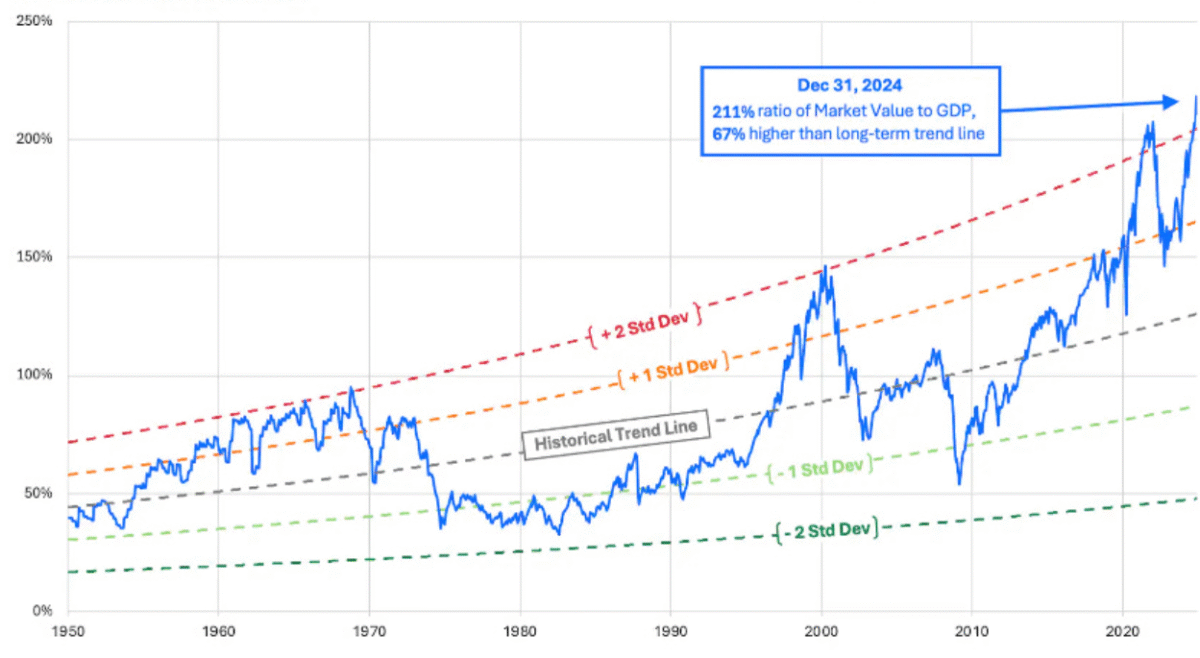
Buffet Indicator current levels.

History lesson


As you might have guessed, the Buffett indicator isn’t anywhere close to the 70% to 80% range right now. It’s slightly over 208%, the highest level the indicator has ever reached!
If you want to know why Buffett isn’t buying many stocks these days, the Buffett indicator probably explains it.

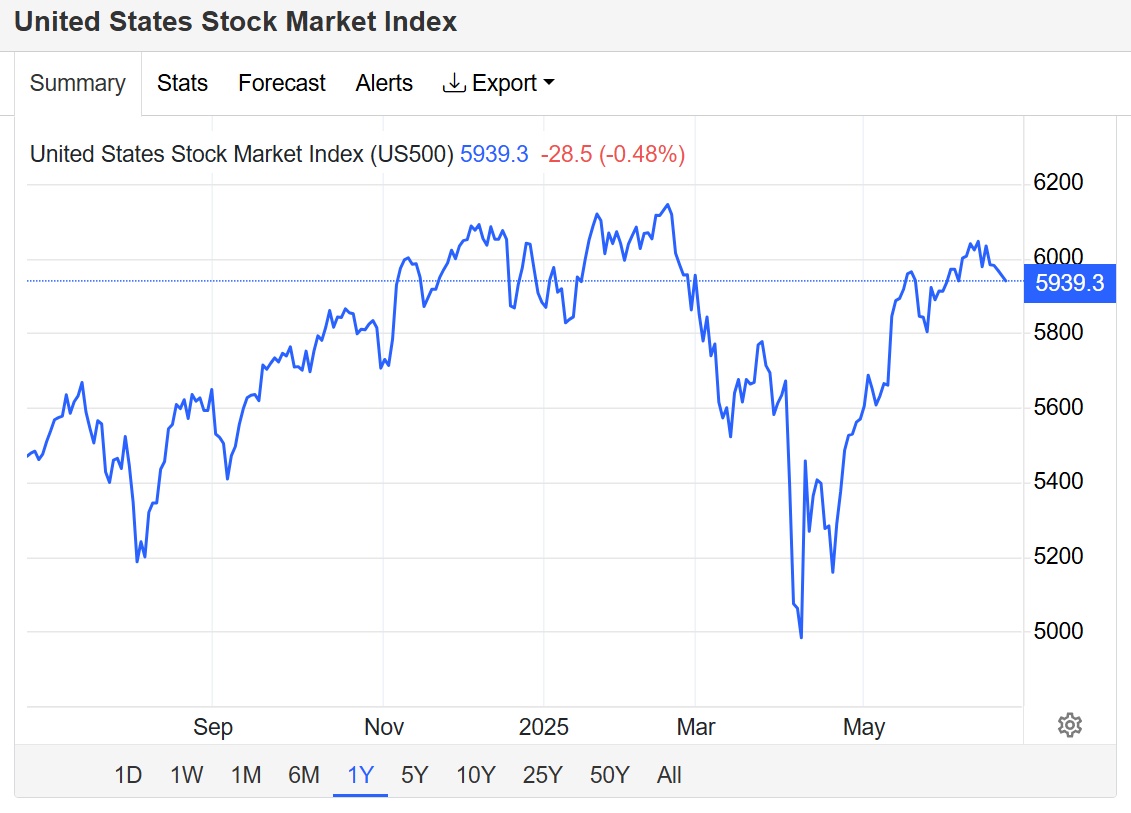
Buffett’s concern about a high market valuation as measured by the Buffett indicator has been justified by history. He mentioned the indicator spiking in 1999 and 2000, reaching what was then an all-time high. Many investors remember what happened soon afterward. The dot-com bubble burst, with the S&P 500(SNPINDEX: ^GSPC) plunging nearly 50% below its previous peak by late 2002.
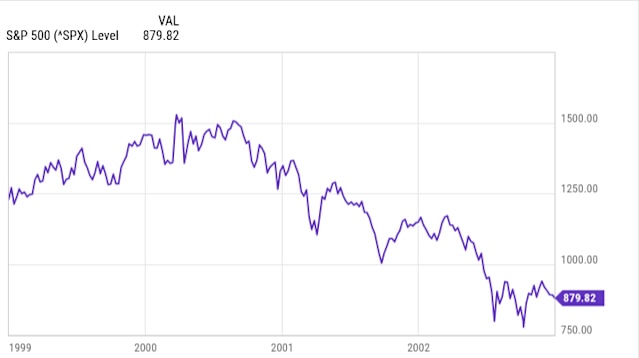
The Buffett indicator again came close to hitting 200% in November 2021. Within a matter of weeks, the S&P 500 began to sink and eventually fell as much as 25%.
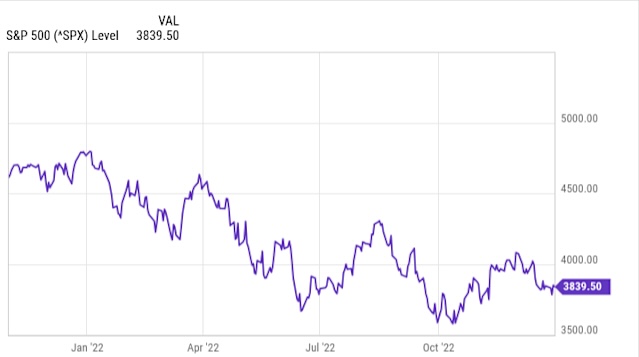
Will the stock market crash again soon?


These historical precedents aren’t encouraging for investors. However, the Buffett indicator isn’t great at predicting short-term stock market moves. For example, the indicator has been above its level in early 2000 (right before the dot-com bubble burst) for most of the period since 2018. During this time, the S&P 500 has soared more than 130%, albeit with significant volatility.
However, there’s no getting around the fact that U.S. stocks are historically expensive.

The Buffett indicator isn’t the only metric that reflects this.

The S&P 500 Shiller CAPE ratio, popularized by Yale economics professor Robert Shiller, is near its third-highest level ever.
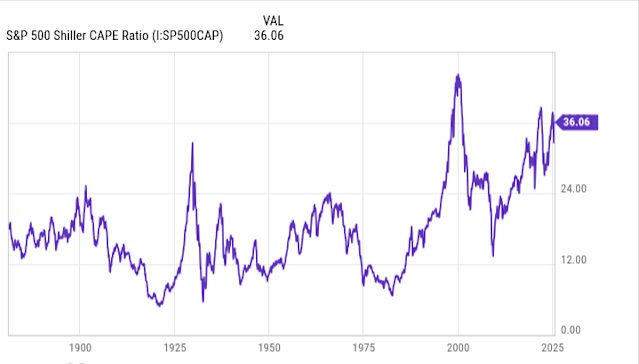
Stock valuations don’t tend to remain above historic levels for too long. Sooner or later, they will return to a more normal range. With the Buffett indicator at an all-time high, investors probably should brace themselves for what the stock market might do over the near term and almost certainly will do eventually – revert to the mean average, meaning huge declines across all global stock market Indices.

What Should Investors Do Now?

Stay disciplined – focus on long-term investment strategies rather than short-term market timing.

Our Strategies at Swap Hunter offer exactly this click here to check them out on our website.

Don’t panic, but be cautious – high valuations increase risk. So it is time to start hedging, find correlated assets and create multiple hedges to balance your portfolio to preserve equity, minimize risk exposure, generate swaps, and create potential to make money on the downside and eventually the upside once the correction is over and markets start recovering.

Diversify your portfolio – to manage volatility. Many stock pickers/investors are moving into Forex, Cryptocurrency ETF’s, Commodities and other Asset Classes.

Cryptocurrencies– Bitcoin, Ethereum, Ripple and Litecoin have had a lot of coverage recently for multiple reasons. Spot Crypto ETF’s and Stable Coins like USDC are gaining a lot traction and attracting many institutional level investors and the Banks with new legislation being passed post the latest U.S. election. We are happy to go into more detail with you in a private consultation.

Canary Capital CEO Steven McClurg sits down with CNBC Crypto World to discuss spot crypto ETFs and regulatory advancements for digital assets in the United States.

Bitcoin could reach $150,000 before facing a bear market: Canary Capital CEO Steven McClurg.

Canary Capital CEO Steven McClurg sits down with CNBC Crypto World to discuss spot crypto ETFs and regulatory advancements for digital assets in the United States.

Other Asset Classes to consider – Renewable Energies, Water, Data Mining, Rare Earth Metals, AI individual stocks and ETF’s are all places you want some exposure.

Indices – we have started taking short positions on the DOW, NASDAQ, S&P500, DAX30 and NIKKEI. Most of these are also offering a positive swap right now.

What Strategy Should investors use?

Strategy is everything. Our Carry Trade strategies at Swap Hunter offer risk minimization, equity preservation and slow and steady wealth generation. we always hear feedback from our clients how our system is low stress and requires little need for them to be glued to their screens all day and night using technical analysis, watching for data releases and news headlines that cause big movements on the markets and will affect their trades.

In trading, a carry trade means earning the difference between the interest rates of two currencies (the swap).

A carry trading indicator like Swap Hunter would help traders spot profitable carry opportunities — ideally before the market prices them in — by tracking interest rate differentials, central bank moves, volatility, and funding costs.

Find the Carry Trades Everyone Else Misses.

Most traders think they know their swap rates — until they wake up and find overnight funding costs quietly drained their profit.

The real edge in carry trading isn’t what your broker publishes — it’s the hidden shifts in funding costs, central bank signals, and liquidity squeezes that flip your positive carry negative before the market prices it in.

That’s the Black Swan that catches everyone — except the ones hunting it.


Before you buy stock in S&P 500 Index, consider:

Swap Hunter just identified what they believe are the best assets and trades for investors to buy now. The 10 trades that made the cut could produce monster returns in the coming years.


Create a stable, well balanced and diversified portfolio with our Swap Hunter software and Strategies

Open your Trading Account with Multibank Group to get 10 Free Training Sessions

Register with Swap Hunter to receive all Benefits mentioned on our Site

    First Name (required)

    Last Name (required)

    Your Email (required)

    GDPR Agreement*
    See our privacy policy to learn more about how we use data.

    🌍 FX Market Update – August 6, 2025

    Open your Trading Account Here to Start Investing on the Financial Markets with MultiBank Group.

    Australian Dollar Leads Gains, Asian Currencies Slip

    The foreign exchange market saw notable movement today, with the Australian Dollar (AUD) emerging as the top gainer, while several Asian currencies faced pressure. Here’s a breakdown of the latest action:


    🔼 Top Currency Gainers

    🇦🇺 Australian Dollar (AUD) – +0.30%

    The AUD surged on the back of robust trade data and stronger commodity prices, outpacing its peers in today’s session.

    💵 Dollar Index (DXY) – +0.02%

    The U.S. Dollar index posted a modest gain as traders remain cautious ahead of upcoming U.S. labor market reports later this week.


    🔽 Top Currency Losers

    🇰🇷 South Korean Won (KRW) – -0.26%

    The KRW dropped the most among major currencies due to export concerns and regional geopolitical uncertainty.

    🇯🇵 Japanese Yen (JPY) – -0.18%

    The JPY weakened as the Bank of Japan stays committed to its ultra-loose monetary stance.

    🇬🇧 British Pound (GBP) – -0.10%

    The GBP slipped after soft inflation data led traders to price in a more dovish outlook from the Bank of England.

    🇪🇺 Euro (EUR) – -0.03%

    The Euro edged slightly lower amid mixed eurozone data and cautious signals from the European Central Bank (ECB).


    📊 FX Performance Summary

    CurrencyChange (%)Movement
    🇦🇺 AUD+0.30%Strong Gain
    💵 DXY+0.02%Mild Upside
    🇪🇺 EUR-0.03%Slight Decline
    🇬🇧 GBP-0.10%Weakening
    🇯🇵 JPY-0.18%Under Pressure
    🇰🇷 KRW-0.26%Sharp Decline

    💬 Market Outlook

    With commodity markets holding firm and economic data rolling in, traders will continue watching central bank policy cues and geopolitical developments. The AUD’s strength may persist if risk sentiment remains positive, while Asian currencies may stay under pressure without regional economic improvement.


    📝 Stay Updated

    Join our Telegram Channel or on WhatsApp for real-time market insights, chart analysis, and strategy tips.

    You can also register your details in this form to stay updated with our Trading Activities and strategies.

      First Name (required)

      Last Name (required)

      Your Email (required)

      Preferred Method of Contact (required)
      eMailPhoneSkypeWhatsApp/Viber/Telegram,etc.

      Your Phone (required)

      Your Mobile

      Your Skype

      Category (required)

      Subject (required)

      Your Message (required)

      I am interested in (tick all that apply):

      GDPR Agreement*
      See our privacy policy to learn more about how we use data.

      Open an Account with our Recommended Broker and get ongoing training and support using Swap Hunter, Market analysis, Strategy assistance and coaching or a fully Managed Account through Copy Trading or PAMM Solutions. Just click on image below and register your Trading account today.

      Open Your Trading Account Here
      Click on Image to Register with Top Broker in the Industry

      UK Retail Sales Edge Up But Challenges Persist

      Open your Trading Account Here to Start Investing on the Financial Markets with MultiBank Group.

      Excerpt:
      The CBI’s retail sales index rose slightly in July 2025 but stayed weaker than expected, showing UK retailers are still battling tough economic conditions. Meanwhile, Hong Kong’s import growth slowed in June as demand shifted across sectors and trading partners.


      📉 UK Retail Sales: Modest Improvement in July

      The Confederation of British Industry’s (CBI) latest monthly retail sales gauge brought a hint of relief for UK retailers. The index climbed to -34 in July, improving from June’s 17-month low of -46. However, this figure still missed analysts’ expectations of -26, underlining how high prices and ongoing economic uncertainty continue to drag on consumer spending.

      Retail sales volumes have now fallen for ten consecutive months, reflecting the squeeze on household budgets. Looking ahead, retailers are slightly more optimistic about August, with the measure of expected sales rising to -31, compared to -49 a month earlier.


      🌏 Hong Kong Imports: Growth Cools in June

      Hong Kong’s imports climbed 11.1% year-on-year to $476.7 billion in June 2025, according to the Census and Statistics Department. While this marks another month of growth, it was the slowest rate in five months, down from May’s sharp 18.9% rise.

      Imports surged from Vietnam (+50.6%), the United Kingdom (+44.7%), mainland China (+17.3%), Thailand (+15.9%) and the United States (+3.9%). However, imports from South Korea saw a sharp decline (-27.1%).

      By product category, there were broad gains in key sectors:

      • Electrical machinery, apparatus and parts rose 14.6% (vs 23.7% in May)
      • Telecommunications equipment increased 17.7%
      • Office machines and data processing equipment rose 9.8%
      • Miscellaneous manufactured articles grew 12.6%
      • Power-generating machinery jumped 38.7%

      In contrast, declines were recorded for non-metallic mineral manufactures (-15.6%), professional and scientific instruments (-9.4%) and petroleum-related products (-10.5%).


      📌 Sources

        First Name (required)

        Last Name (required)

        Preferred Method of Contact (required)

        eMailPhoneSkypeWhatsApp/Viber/Telegram,etc.


        Your Email (required)

        Your Phone (required)

        Your Mobile

        Your Skype

        Your Message (required)

        I am interested in (tick all that apply):

        GDPR Agreement*
        See our privacy policy to learn more about how we use data.

        open an Account with MEX Atlantic part of MultiBank Group
        Open your Trading Account with MEX Atlantic MultiBank Group Here

        U.S. Mortgage Applications Surge, Markets Rally Amid Trade Developments, and Mexico Inflation Softens

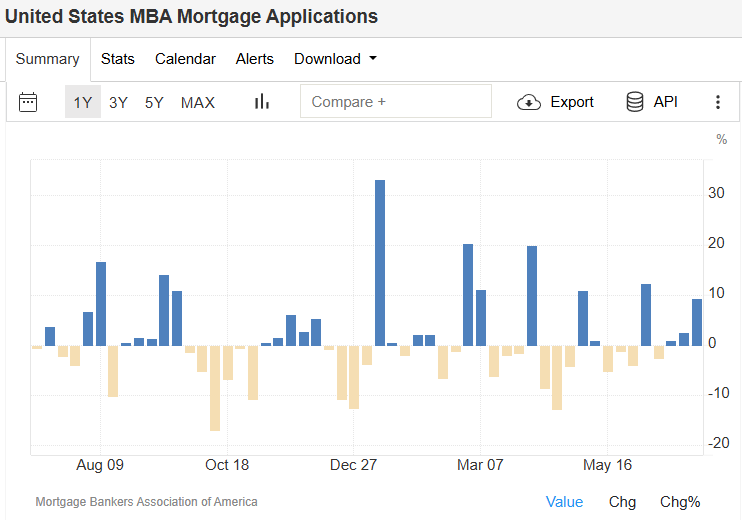
        Mortgage Applications See Strongest Weekly Rise in a Month

        In the first week of July 2025, the volume of U.S. mortgage applications soared by 9.4% from the previous week — the largest increase in a month, according to data from the Mortgage Bankers Association. This marks the third consecutive weekly gain, the longest streak since December 2024, as benchmark mortgage rates dipped to their lowest since April.

        Refinancing activity, which tends to respond quickly to changes in short-term rates, jumped 9% week-over-week and surged 56% compared to the same period in 2024. Similarly, purchase applications rose 9% on the week and were up 25% year-over-year, highlighting renewed strength in the housing market. source: Mortgage Bankers Association of America


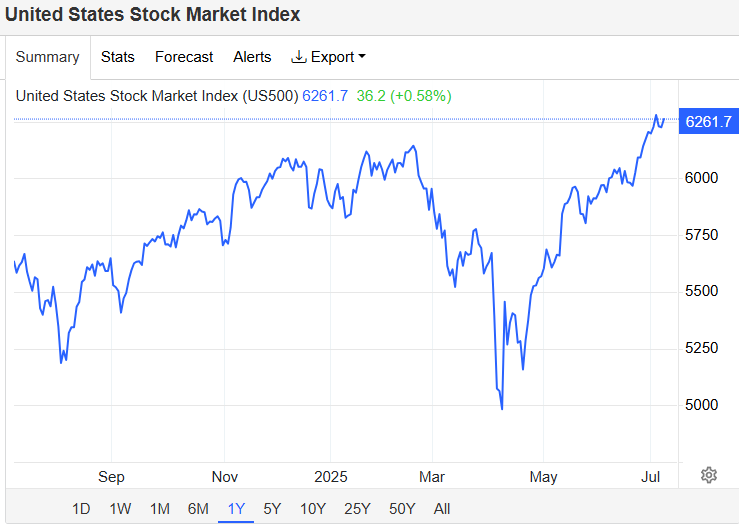
        Markets Edge Higher on Trade Announcements and Fed Speculation

        U.S. equities closed higher on Wednesday as traders digested updates on trade policy and awaited the Federal Reserve’s next moves. The S&P 500 gained 0.5%, the Nasdaq climbed 0.7%, and the Dow Jones rose by nearly 200 points.

        President Trump signaled that major trade announcements would be made, including a planned 50% tariff on copper imports and potential 200% tariffs on pharmaceuticals, though implementation is delayed by 12–18 months to give industries time to adapt.

        Market participants are closely watching for the FOMC minutes release, which may offer insights into the timing of potential interest rate cuts. Expectations remain strong for two 25 basis point cuts before year-end.

        Technology stocks led gains, with Nvidia up 2.2% and Microsoft rising 1.2%. Apple shares were flat, following a statement by White House Trade Counselor Peter Navarro suggesting the company considers itself “too big to tariff.”


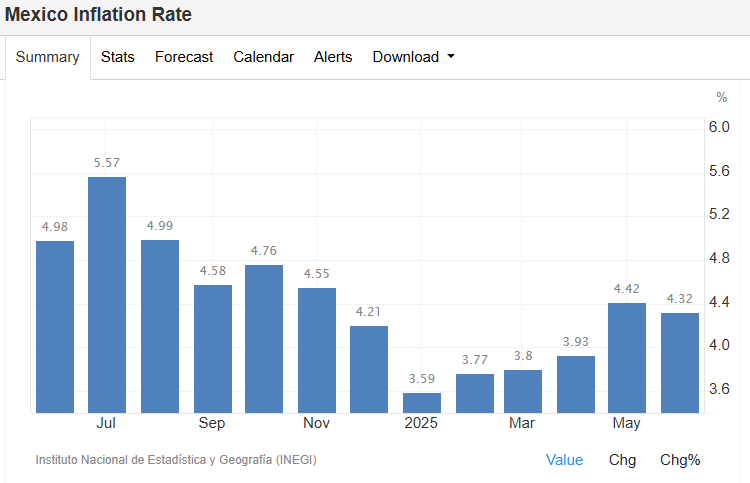
        Mexico’s Inflation Slows but Core Pressures Rise

        Mexico’s annual inflation rate eased to 4.32% in June 2025, down slightly from 4.42% in May, aligning closely with market expectations of 4.31%, according to the national statistics agency INEGI.

        Price growth moderated in agriculture (5.04% vs 6.76%) and energy (3.56% vs 3.93%), while accelerating for goods, food, beverages, and services. Notably, core inflation ticked up to 4.24%, suggesting that underlying price pressures remain sticky.

        On a monthly basis, inflation was unchanged at 0.28%, maintaining the same pace as in May.  Instituto Nacional de Estadística y Geografía (INEGI)


        Conclusion

        With falling mortgage rates energizing the U.S. housing market, equity markets buoyed by trade policy hints, and inflation trends in Mexico showing mixed signals, July 2025 is shaping up to be a pivotal month for both investors and policymakers.

        Stay tuned for more updates on monetary policy, inflation data, and global economic trends.

          First Name (required)

          Last Name (required)

          Your Email (required)

          Preferred Method of Contact (required)
          eMailPhoneSkypeWhatsApp/Viber/Telegram,etc.

          Your Phone (required)

          Your Mobile

          Your Skype

          Category (required)

          Subject (required)

          Your Message (required)

          I am interested in (tick all that apply):

          GDPR Agreement*
          See our privacy policy to learn more about how we use data.

          Open Your MultiBank Trading Account Here

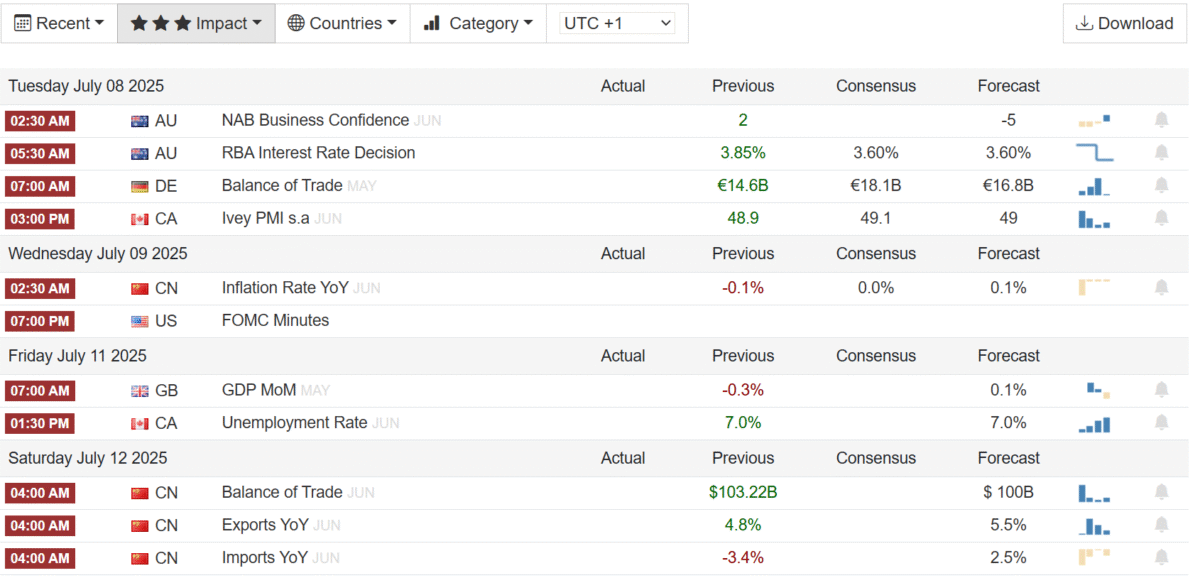
          Markets eye US tariff deadline, FOMC minutes, global central bank moves, and key data from China, Germany, UK, and Canada in the week of July 7.

          🌍 Global Themes

          • Trade Tensions Return: The July 9th deadline marks the end of the US tariff pause. Only partial deals (UK, Vietnam, China framework) are in place. Markets are bracing for possible escalations and their impact on global trade flows.
          • Fed Watch: Investors await the FOMC minutes and several Fed speeches to gauge the outlook for interest rates. Chair Powell maintains a cautious tone, but markets want more clues on the path for policy in H2.
          • Central Bank Decisions: Policy meetings in Australia, South Korea, Malaysia, and New Zealand could signal regional divergence amid slowing global growth and easing inflation.

          🇺🇸 United States

          • Tariff Deadline: High stakes around the July 9th expiration of tariff relief. Key sectors may face higher import costs unless further agreements are reached.
          • Fed & Data:
            • FOMC minutes and Fed speeches in focus.
            • Data includes: Weekly jobless claims, consumer credit, NFIB Small Business Index, and budget statement.
          • Earnings Season Kickoff:
            • Watch Delta Air Lines and Conagra Brands earnings on Thursday for early corporate sentiment.

          🇨🇦 Canada

          • June Jobs Report and Ivey PMI will shape expectations around Bank of Canada’s next move.

          🇲🇽 Mexico & 🇧🇷 Brazil

          • Mexico: June inflation report will guide Banxico’s next rate decision.
          • Brazil: Updates on inflation, retail sales, and business confidence are due.

          🇪🇺 Europe

          • Germany: Expected second monthly industrial production decline, plus trade, wholesale prices, and final inflation data.
          • Eurozone: First dip in retail sales in 5 months.
          • UK: Key data on monthly GDP, industrial output, trade balance, and Halifax house prices.
          • Italy & France: Final inflation and industrial figures.
          • Others: Switzerland (consumer confidence), Turkey (IP), Russia (inflation).

          🌏 Asia-Pacific

          • China:
            • CPI likely flat; PPI deflation to ease (still -3.2% y/y).
          • Japan:
            • Full slate of data: wages, current account, machine orders, producer prices.
          • Australia:
            • RBA decision: Third rate cut (25 bps) expected.
          • South Korea & Malaysia:
            • Monetary policy updates amid growth concerns.
          • New Zealand:
            • RBNZ to hold at 3.25%.
          • Others:
            • Inflation data: Vietnam, Thailand, Taiwan.
            • Singapore: GDP growth to be closely watched.

            First Name (required)

            Last Name (required)

            Your Email (required)

            Preferred Method of Contact (required)
            eMailPhoneSkypeWhatsApp/Viber/Telegram,etc.

            Your Phone (required)

            Your Mobile

            Your Skype

            Category (required)

            Subject (required)

            Your Message (required)

            I am interested in (tick all that apply):

            GDPR Agreement*
            See our privacy policy to learn more about how we use data.

            Open an Account with MEX Atlantic, Mulibank Group to Trade on over 20,000 assets

            U.S. Nonfarm Payrolls Beat Expectations in June 2025 Amid Economic Resilience

            U.S. Nonfarm Payrolls Rise 147K in June, Topping Expectations

            The U.S. economy added 147,000 jobs in June 2025, according to the Bureau of Labor Statistics, surpassing forecasts of 110,000 and marking a slight uptick from an upwardly revised 144,000 in May. The latest reading aligns with the 12-month average of 146,000, continuing to demonstrate labor market resilience despite economic headwinds.

            Government jobs made up nearly half the gains, adding 73,000 positions, primarily in state education (+40K) and local education (+23K). Federal government employment, however, declined by 7,000, continuing a downtrend since its January peak.

            Healthcare remained a key driver, adding 39,000 jobs, with hospitals (+16K) and nursing and residential care facilities (+14K) leading the way. Social assistance roles also grew by 19,000.

            ⚠️ Analysts caution that a hiring slowdown could emerge as uncertainty surrounding tariffs, trade, and immigration policies persists.


            ISM Services PMI Rebounds to 50.8

            The ISM Services PMI climbed to 50.8 in June, up from 49.9 in May, exceeding expectations of 50.5. This signals a return to modest growth in the services sector after a brief contraction.

            Key highlights:

            • Business activity rose to 54.2 (vs 50.0)
            • New orders rebounded to 51.3 (vs 46.4)
            • Inventories and export orders also improved
            • Price pressures eased slightly to 67.5 from 68.7

            However, concerns about tariffs and slowing supplier delivery performance (50.3 vs 52.5) remain prevalent. Middle East tensions were noted for the first time, though no direct supply disruptions were reported.


            U.S. Trade Deficit Widens Sharply

            The U.S. trade deficit widened to $71.5 billion in May, up from $60.3 billion in April, as exports dropped 4% to $279 billion, led by declines in nonmonetary gold, natural gas, and finished metal shapes. Imports dipped just 0.1% to $350.5 billion.

            Major trade gap increases:

            • EU: -$22.5B (from -$17.9B)
            • Mexico: -$17.1B (from -$13.5B)
            • Canada and Vietnam: modest increases
            • China: narrowed to -$14B (from -$19.7B)

               source: Bureau of Economic Analysis (BEA)

            Markets Rally on Strong Jobs Data and AI Optimism

            All three major U.S. indices climbed over 0.8% on Thursday, with the S&P 500 and Nasdaq 100 closing at record highs. The strong June payroll report and an unexpected drop in the unemployment rate to 4.1% fueled investor confidence.

            Big movers:

            • Nvidia: +1.3%
            • Synopsys: +4.2% on lifted U.S. export restrictions to China
            • Cadence Design & Synopsys: ~+5% on AI strength
            • Datadog: +10% on S&P 500 inclusion

            Optimism also stemmed from progress in the U.S.-Vietnam trade deal and the House nearing final approval of President Trump’s $3.4 trillion tax-and-spending bill.


            Key Takeaways

            • Labor market continues to show strength but faces downside risks.
            • Services sector rebounds, though growth remains modest.
            • Trade imbalance widens on export slump.
            • Stock market surges on tech gains and policy optimism.

            Conclusion

            The June 2025 economic indicators paint a mixed yet cautiously optimistic picture. While the labor market and services sector show resilience, trade imbalances and policy uncertainty loom large. Investors appear encouraged by tech sector momentum and fiscal stimulus prospects, but volatility could reemerge as global tensions and trade debates evolve.

              First Name (required)

              Last Name (required)

              Your Email (required)

              Preferred Method of Contact (required)
              eMailPhoneSkypeWhatsApp/Viber/Telegram,etc.

              Your Phone (required)

              Your Mobile

              Your Skype

              Category (required)

              Subject (required)

              Your Message (required)

              I am interested in (tick all that apply):

              GDPR Agreement*
              See our privacy policy to learn more about how we use data.

              open an Account with MEX Atlantic part of MultiBank Group

              US Stocks Surge as Tariff Truce and Fed Rate Cut Hopes Fuel Rally | June 2025 Market Update

              US stock market chart hitting record highs in June 2025

              📈 US Stocks Surge as Fed Cut Hopes and Trade Truce Drive Gains

              Published: June 30, 2025
              Category: Markets & Economy

              US equities rallied on Monday, extending last week’s gains as easing trade tensions and growing expectations of interest rate cuts by the Federal Reserve pushed major indexes to record highs.


              🔼 Major Indexes Reach New Highs

              • S&P 500 and Nasdaq 100: Up 0.5% each
              • Dow Jones Industrial Average: Gained over 200 points

              📰 Market Drivers

              1. 🇺🇸 US-China Trade Agreement

              The US and China announced a formal agreement to prevent new tariffs, with President Trump showing flexibility on the July 9 deadline for reintroducing reciprocal tariffs. This marks a major de-escalation from past tensions, when tariffs reached up to 145%.

              2. 🏦 Fed Rate Cut Expectations Rise

              Investor confidence is rising as soft inflation data and global uncertainties increase the likelihood of multiple Fed rate cuts in 2025.

              3. 💻 Tech Sector Strengthens

              • Canada scrapped its digital services tax, boosting US tech stocks and reopening trade talks.
              • Meta and Alphabet shares rose 1%.
              • Juniper Networks soared 9% after the DoJ approved its HP acquisition, settling a legal dispute.

              💶 Eurozone: Euro Hits $1.17 as German Inflation Falls

              The euro rose to its highest level since September 2021, trading just above $1.17, bolstered by:

              • Weaker US dollar from dovish Fed sentiment
              • Fiscal concerns in the US
              • Cooling inflation in Germany

              🇩🇪 Germany Inflation Back to Target

              According to the Federal Statistical Office:

              • CPI fell to 2.0% in June, down from 2.1%, beating forecasts
              • Core inflation eased to 2.7%, a 3-month low
              • Food inflation slowed to 2.0%, energy prices dropped -3.5%
              • Monthly CPI was flat, following a 0.1% rise in May

              🏦 ECB Policy Outlook

              While inflation edged up slightly in France, Italy, and Spain, the ECB maintains a cautious approach.
              Vice President Luis de Guindos reaffirmed that the current policy is appropriate, but warned of the need for flexibility amid economic uncertainty.

              Markets continue to price the ECB’s terminal rate around 1.75%–1.80%.


              📊 Key Takeaways

              • ✅ US markets are responding positively to reduced geopolitical risk and a potential easing cycle from the Fed.
              • ✅ Eurozone inflation data provides mixed signals but supports a stable ECB outlook.
              • ✅ Tech stocks may continue to benefit from regulatory relief and favorable trade shifts.

              🧠 Related Reads:

                First Name (required)

                Last Name (required)

                Your Email (required)

                Preferred Method of Contact (required)
                eMailPhoneSkypeWhatsApp/Viber/Telegram,etc.

                Your Phone (required)

                Your Mobile

                Your Skype

                Category (required)

                Subject (required)

                Your Message (required)

                I am interested in (tick all that apply):

                GDPR Agreement*
                See our privacy policy to learn more about how we use data.

                trade multiple assets on the safest platform in the industry

                Euro Area Economic Sentiment Indicator Falls to 94 in June 2025 Amid Industry Weakness

                EU economic sentiment

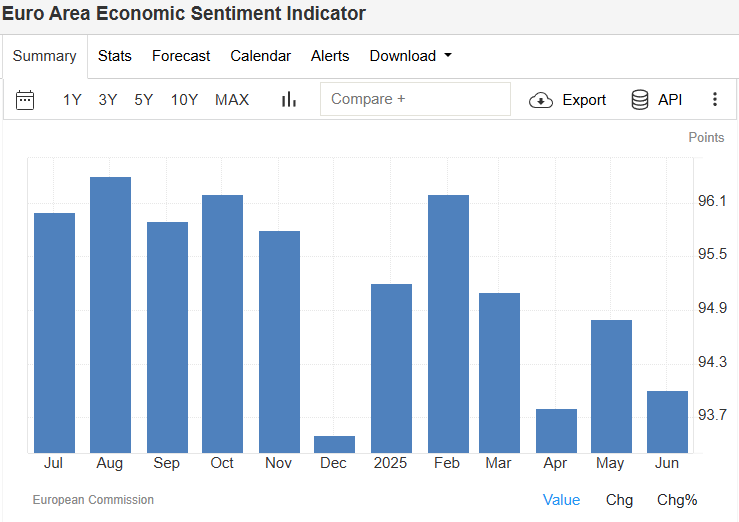
                Euro Area Economic Sentiment Indicator Falls to 94 in June 2025

                The Economic Sentiment Indicator (ESI) for the Euro Area dropped to 94 in June 2025, down from 94.8 in May and well below market expectations of 95.1, according to the latest data from the European Commission.


                📉 Key Drivers of the Decline

                The drop in sentiment was largely driven by the industrial sector, where confidence slipped to -12 from -10.4 in the previous month. The decline reflects:

                • Lower order book assessments
                • Higher stocks of finished products
                • Weaker production expectations

                Additional declines were observed in:

                • Retail confidence: -7.5 (vs -7.2 in May)
                • Consumer confidence: -15.3 (vs -15.1)

                📈 Sectors Showing Improvement

                Despite the overall downturn, two sectors posted gains:

                • Services: Confidence improved to 2.9 (from 1.8)
                • Construction: Rebounded slightly to -2.8 (from -3.5)

                🌍 Country-Level Highlights

                Biggest Declines:

                • France: 89.6 (down from 93)
                • Spain: 102 (down from 103.4)
                • Germany: 90.7 (down from 91.5)

                Stable or Improving:

                • Poland: 101.4 (up from 100.4)
                • Italy: 98.9 (vs 98.7)
                • Netherlands: 97.1 (vs 96.9)

                🔎 What It Means for the Eurozone

                The data suggest ongoing economic weakness across the Eurozone, particularly in manufacturing and retail sectors. While services and construction offer some support, the overall picture points to fragile business and consumer confidence as the region navigates 2025.

                This divergence between countries—particularly the downturn in France and Germany—highlights uneven recovery dynamics within the EU bloc.
                source: European Commission


                Stay tuned for more updates on EU economic indicators and what they mean for markets and policy.

                  First Name (required)

                  Last Name (required)

                  Preferred Method of Contact (required)

                  eMailPhoneSkypeWhatsApp/Viber/Telegram,etc.


                  Your Email (required)

                  Your Phone (required)

                  Your Mobile

                  Your Skype

                  Your Message (required)

                  I am interested in (tick all that apply):

                  GDPR Agreement*
                  See our privacy policy to learn more about how we use data.

                  Oil, Gold, and Dollar Markets React as US–Iran Talks Loom

                  WTI crude oil, gold prices, and the US dollar index all moved significantly on Thursday as geopolitical developments, Fed policy signals, and economic data shaped market sentiment.


                  Crude Oil Prices Rise Ahead of US–Iran Talks and OPEC+ Meeting

                  WTI crude oil futures climbed above $65 per barrel on Thursday, building on recent gains and recovering from earlier losses in the week. The rally comes as investors await high-stakes talks between the US and Iran scheduled for next week. These discussions aim to reduce tensions in the Middle East and limit Tehran’s nuclear ambitions.

                  The move follows President Trump’s reaffirmation of the maximum pressure campaign, including restrictions on Iranian oil exports. However, he also hinted at possible enforcement leniency to support Iran’s reconstruction, suggesting China may continue importing Iranian crude.

                  In a sign of strong demand, US crude inventories dropped by 5.8 million barrels, reaching an 11-year seasonal low. Cushing stockpiles also fell to the lowest since February.

                  Markets are now turning their focus to the upcoming OPEC+ meeting on July 6, where the group will set its production policy for August. Russia may support a supply increase if conditions warrant it.


                  Gold Prices Edge Higher on Weaker Dollar, Geopolitical Relief

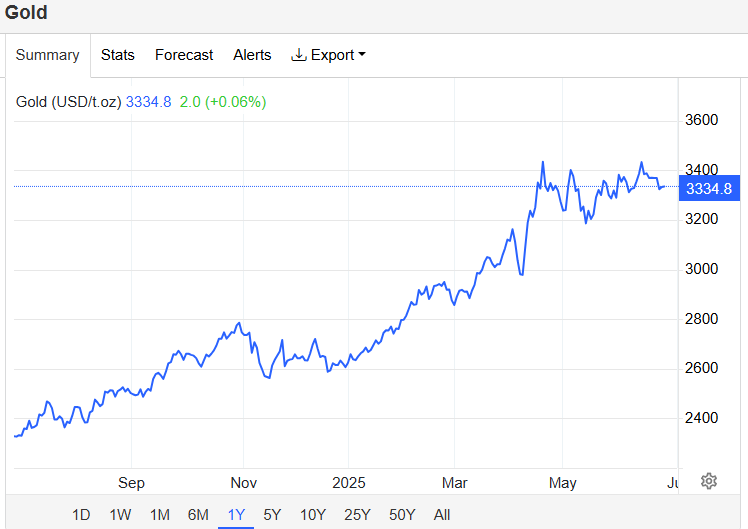
                  Gold prices rose toward $3,340 per ounce, extending gains from the previous session. The weaker US dollar and falling Treasury yields provided support, while easing geopolitical tensions added a further boost.

                  Next week’s US–Iran talks have sparked cautious optimism in markets. While the ceasefire between Iran and Israel is holding, concerns about its durability remain.

                  Meanwhile, Fed Chair Jerome Powell, in his second day of testimony, maintained a balanced stance—acknowledging inflation risks from tariffs but holding off on immediate rate cuts. Nonetheless, weak consumer confidence in June raised fresh concerns about the labor market and trade uncertainty, potentially strengthening the case for future easing.

                  Markets are now closely watching key data, including Thursday’s final Q1 GDP reading and initial jobless claims, followed by PCE price data on Friday.


                  US Dollar Slides to Three-Year Low Amid Rate Cut Expectations

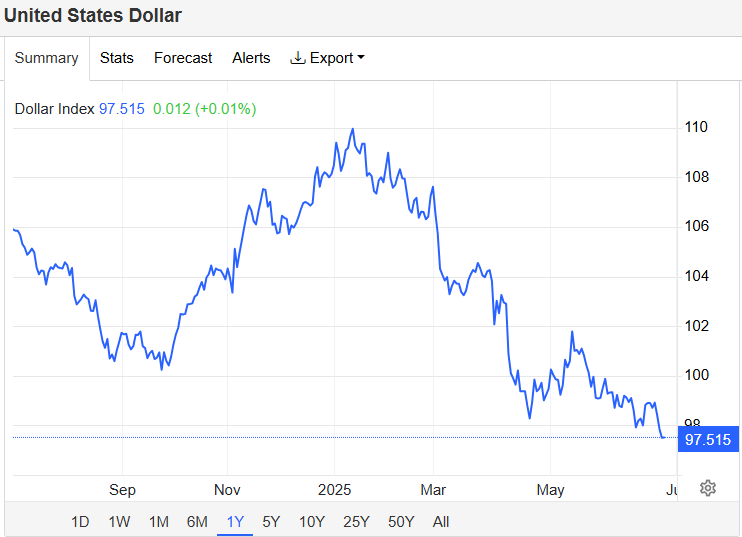
                  The US dollar index fell to around 97.5, marking its lowest level in over three years. The decline reflects a mix of easing geopolitical tensions, growing fiscal worries, and expectations of Federal Reserve rate cuts.

                  With the ceasefire between Iran and Israel seemingly stable and US–Iran negotiations on the horizon, risk sentiment improved. On the policy front, Chair Powell reiterated a cautious stance, stating that while tariffs may drive inflation, the Fed would likely continue easing absent those pressures.

                  Traders are now pricing in over 60 basis points of rate cuts by year-end, with the next move anticipated in September. Attention is also turning to US trade negotiations ahead of President Trump’s July 9 deadline, and efforts in Congress to finalize a tax and spending package around the same period.


                  Looking Ahead

                  Markets are poised for more volatility as geopolitical, economic, and policy developments continue to unfold. Investors should watch closely for:

                  • US–Iran nuclear talks next week
                  • July 6 OPEC+ meeting outcomes
                  • Upcoming US economic data (GDP, jobless claims, PCE)
                  • Fed policy signals amid global trade uncertainty

                  Stay tuned for further updates as these stories evolve.

                  Fill out the registration form below to receive a FREE consultation from Swap Hunter

                    First Name (required)

                    Last Name (required)

                    Preferred Method of Contact (required)

                    eMailPhoneSkypeWhatsApp/Viber/Telegram,etc.


                    Your Email (required)

                    Your Phone (required)

                    Your Mobile

                    Your Skype

                    Your Message (required)

                    I am interested in (tick all that apply):

                    GDPR Agreement*
                    See our privacy policy to learn more about how we use data.

                    Open your Trading Account with MEX Atlantic, part of the MultiBank Group

                    Click on this image to open your MEX Atlantic, Multibank Group trading account.

                    U.S. Housing Market Slumps in May 2025 | Fed Dovish, Tech Stocks Rally

                    🏠 U.S. New Home Sales Plunge in May 2025 as Buyers Retreat Amid High Mortgage Rates

                    New single-family home sales in the U.S. fell sharply in May 2025, dropping 13.7% month-over-month to a seasonally adjusted annualized rate of 623,000 units, according to the U.S. Census Bureau. This marks the biggest decline since June 2022, far below market expectations of around 700,000 units.

                    📉 Housing Market Breakdown:

                    • South: -21% to 349,000 units
                    • West: -5.4% to 159,000 units
                    • Midwest: -7.1% to 78,000 units
                    • Median home price: $507,000 (+1.4%)
                    • Supply: 9.8 months at current sales pace

                    High mortgage rates and economic uncertainty are causing many potential buyers to delay purchases, signaling a cooling housing market despite rising prices.


                    📊 Stock Market Update: Tech Leads, Real Estate Lags

                    The S&P 500 rose 0.2% on Wednesday, while the Nasdaq 100 gained 0.4%, inching closer to a new all-time high. The Dow Jones remained near flatline levels.

                    Top Performers:

                    • Nvidia: +1.3%
                    • Apple: +1.2%
                    • Microsoft: +0.6%
                    • Amazon: +1.1%
                    • Meta: +0.2%

                    Underperformers:

                    • Real Estate sector (reflecting weak housing data)
                    • FedEx: -5% after disappointing profit forecast

                    Investor sentiment was buoyed by Fed Chair Jerome Powell’s dovish testimony before Congress, which reinforced expectations of at least two interest rate cuts by the end of 2025. In addition, a ceasefire between Iran and Israel helped calm global markets.


                    💵 Dollar Index Holds as Fed Signals Policy Flexibility

                    The U.S. Dollar Index (DXY) held steady at 98 on Wednesday, pausing its recent slide to multi-year lows.

                    Key Drivers:

                    • Powell’s remarks: Economic uncertainty justifies patience on interest rates
                    • Disinflation outlook: Maintained as long as no new tariffs are introduced (watch for July 9 deadline)
                    • Energy prices: Falling due to stability in the Strait of Hormuz, boosting bets on slowing inflation

                    Meanwhile, other major economies are also leaning toward monetary easing, helping to stabilize the greenback despite rate cut expectations in the U.S.


                    📌 Final Thoughts: What to Watch Next

                    • Will housing weakness extend into summer?
                    • Can tech continue to lead the market higher?
                    • July 9 tariff decision will be critical for inflation and Fed policy
                    • Watch for inflation and jobs data to confirm (or challenge) rate cut bets

                    📬 Stay tuned for more market insights and economic updates.
                    📢 Don’t forget to share this post and leave a comment below with your thoughts on where the market is headed next!

                      First Name (required)

                      Last Name (required)

                      Preferred Method of Contact (required)

                      eMailPhoneSkypeWhatsApp/Viber/Telegram,etc.


                      Your Email (required)

                      Your Phone (required)

                      Your Mobile

                      Your Skype

                      Your Message (required)

                      I am interested in (tick all that apply):

                      GDPR Agreement*
                      See our privacy policy to learn more about how we use data.